The Skill That Beats Certifications Every Time
Do you REALLY need that certificate?

Early in my career, I thought I understood what made someone valuable.
I thought it was knowledge. I thought it was credentials. I thought it was the ability to say, “I know how to do this,” and have something official to back it up.
So like a lot of people, I looked at certifications as a shortcut. A way to prove I belonged in the room before I had fully earned it.
But over time, sitting on the other side of the table - hiring, building teams, fixing broken projects - I realized something uncomfortable:
Most people aren’t losing opportunities because they lack certifications.
They’re losing them because they can’t tell the story of what they’ve actually done.
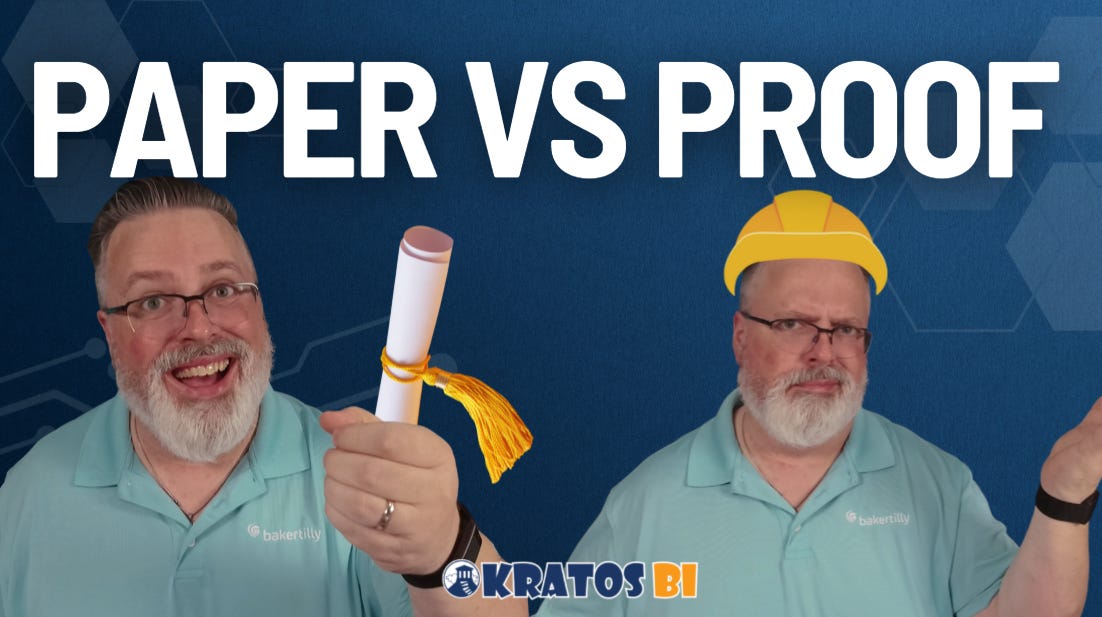
The Craftsman Who Can’t Describe the House
Imagine two builders.
The first one shows up with a binder full of certifications. He can name every tool, every technique, every possible way to construct a house. He’s studied architecture, memorized frameworks, passed every exam you can throw at him.
The second one walks in with no binder. No badges. Just a quiet confidence.
You ask him what he’s built.
And he doesn’t say, “I know framing.”
He says, “I built a 3,000 square foot home on uneven ground where the original foundation kept shifting. We had to redesign the support structure mid-build, reinforce the load-bearing walls, and still hit the deadline before winter. The client moved in on time, and we haven’t had a single structural issue in five years.”
One of these people knows construction.
The other has proven they can handle reality.
Now here’s the part most people miss.
There are far more people like the second builder than you think… they just don’t know how to talk like that.
Experience Isn’t the Advantage - Communicating It Is
I’ve interviewed incredibly capable people who struggled to get hired.
Not because they lacked skill. Not because they lacked experience.
But because when asked what they did, they gave answers like:
“I worked on data pipelines.”
“I helped build dashboards.”
“I was part of a migration project.”
That’s not experience.
That’s a job description.
It’s like describing a championship game by saying, “I played basketball.”
Meanwhile, someone else - sometimes with less real experience - tells the story differently:
“We had a pipeline that was failing every night at 2 AM, and it was delaying executive reporting by hours. I traced it back to a transformation bottleneck, redesigned that portion of the flow, and cut processing time by 60%. That change alone got reports back in front of leadership before the start of the business day.”
Now you’re not just hearing what they did.
You’re seeing how they think.
You’re seeing how they operate under pressure.
You’re seeing impact.
Certifications Are Maps. Experience Is Terrain.
A certification teaches you the map.
It shows you the roads, the landmarks, the ideal paths someone else has already drawn out.
And maps are useful… until you actually step into the terrain.
Because in the real world, roads are closed. Weather changes. The bridge you planned to cross doesn’t exist anymore.
And that’s where experience shows up.
Experience is knowing how to reroute without panicking. It’s knowing which trade-offs matter and which ones don’t. It’s understanding that the “best practice” on paper isn’t always the best decision in context.
But here’s the truth that people don’t like to hear:
If you can’t explain how you navigated that terrain… it’s almost as if you never went there at all.
The Hidden Career Skill Nobody Teaches
No one teaches you how to quantify your experience.
No one teaches you how to turn “I worked on this” into “this is the problem I solved, this is how I approached it, and this is the measurable outcome.”
So people default to certifications because they’re easier to point to.
A certification is clean. It’s simple. It’s universally understood.
But it’s also shallow.
Learning how to communicate your experience is harder. It forces you to reflect. To break down what actually mattered. To separate what you touched from what you owned.
It requires you to answer uncomfortable questions like:
What changed because I was there?
What got better?
What would have gone wrong if I hadn’t been involved?
That’s not just storytelling.
That’s clarity.
And clarity is what people hire.
The Difference Between Knowing and Being Trusted
At the end of the day, hiring isn’t about who knows the most.
It’s about who can be trusted when things get messy.
Certifications might get you into the conversation.
But trust is built when someone can clearly articulate how they’ve handled real situations, made decisions under pressure, and delivered outcomes that mattered.
That’s what separates someone who has studied the craft from someone who has lived it.
The Shift That Changes Everything
If you want to accelerate your career, stop asking:
“What certification should I get next?”
Start asking:
“How do I better tell the story of what I’ve already done?”
Because buried inside your past projects are the exact proof points someone else is looking for.
You just haven’t learned how to surface them yet.
And once you do, something changes.
You stop trying to prove you belong…
…and start showing people why they need you.
Now go out and make today the BEST DAY EVER!!!