OneLake Keeps Pulling Fabric and Databricks Closer Together
Every new integration makes the Fabric vs. Databricks debate a little less relevant

I was reading Microsoft’s latest announcement this week:
Extending interoperability: Azure Databricks can now store Unity Catalog managed tables in OneLake.
And it reinforced something I’ve believed for a long time.
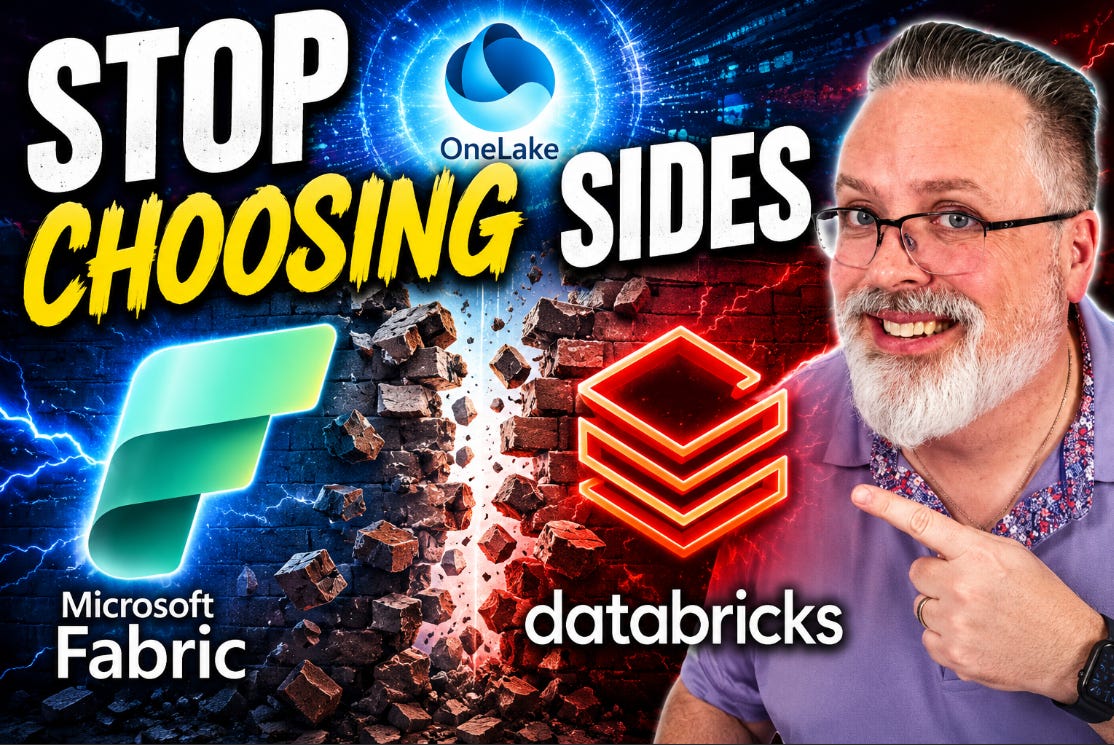
The Fabric versus Databricks debate is becoming less important every year.
A few years ago, choosing a data platform felt like choosing sides.
If your organization invested in Databricks, people assumed you wouldn’t use Fabric.
If you invested in Fabric, people assumed Databricks would eventually disappear.
That has never reflected reality inside large enterprises.
When I walk into organizations, I don’t find a single platform. I find data engineers, BI developers, analysts, data scientists, and architects. Each group has different needs, different skills, and different tools they prefer to use.
The challenge was never the tools.
The challenge was the distance between them.
Every time data had to be copied from one platform to another, complexity showed up. Storage costs increased. Pipelines multiplied. Governance became harder. Teams spent more time moving data than creating value from it.
That’s why this announcement matters.
Azure Databricks can now store Unity Catalog managed tables directly in OneLake.
On the surface, that sounds like an infrastructure enhancement. Underneath, it’s another major step toward a shared data foundation where organizations can focus less on where data lives and more on what they can do with it.
Think about the path we’ve been on.
Fabric gained the ability to work with Unity Catalog data.
Databricks gained access to OneLake data.
Now Unity Catalog managed tables themselves can live inside OneLake.
Each announcement removes another reason to duplicate data.
Each announcement reduces another integration hurdle.
Each announcement makes it easier for teams to work together without forcing everyone onto the same tool.
That’s what gets me excited.
For years, architecture conversations started with the wrong question.
“Should we use Fabric or Databricks?”
The better question is:
“Which tool is best for this workload?”
A company might choose Databricks for advanced engineering and machine learning. The same company might choose Fabric for semantic modeling, Power BI, governance, and self-service analytics.
Those strengths don’t compete with each other.
They complement each other.
The closer Microsoft and Databricks bring these platforms together, the more organizations can focus on outcomes instead of integration projects.
The future I’m seeing isn’t one where every company standardizes on a single analytics platform.
It’s one where data stays in place, governance remains consistent, and teams work in the tools that help them move fastest.
That’s why announcements like this matter.
They’re not really about another feature.
They’re about removing another barrier between people and the value hidden inside their data.
And that’s a future worth getting excited about.
BEST DAY EVER!!!